

In one minute
What is Durga Puja?
Durga Puja (often called simply Pujo) is a Hindu festival honouring the goddess Durga - the divine mother who protects the world from evil. It is the biggest festival of the year for the Hindu community worldwide, celebrated each autumn with grand festivities and community gatherings across India, Bangladesh, and the global diaspora.
It is both a religious and a cultural festival: alongside prayers and rituals there is music, dance, art, new clothes, shared food and the joy of meeting family and friends. That is why people of every background are welcome to join in.
- What it celebrates
- The victory of good over evil - Maa Durga defeating the demon Mahishasura.
- When
- Autumn (Sept–Oct), in the Bengali month of Ashwin, following the lunar calendar.
- How long
- Traditionally 5 main days, Shashthi to Dashami. In Kuopio: 16–17 October 2026.
- Who can come
- Everyone - all faiths, all cultures, all ages. You don't need to be Hindu or Bengali.
The legend
The story of Maa Durga
The story comes from the Devi Mahatmya (“Glory of the Goddess”), an ancient Sanskrit text. The demon king Mahishasura had won a boon that no man or god could kill him. Made arrogant by this power, he drove the gods out of heaven and brought fear and chaos to the world.
The gods - Brahma, Vishnu, Shiva and all the others - combined their energies into a blazing light. From that light a goddess was born: Durga, “the one who is hard to defeat”. Each god gave her a weapon, and the Himalaya gave her a lion to ride. For nine days and nights she fought Mahishasura as he changed shape - buffalo, lion, elephant, man - and on the tenth day, Vijaya Dashami (“the tenth day of victory”), she defeated him.
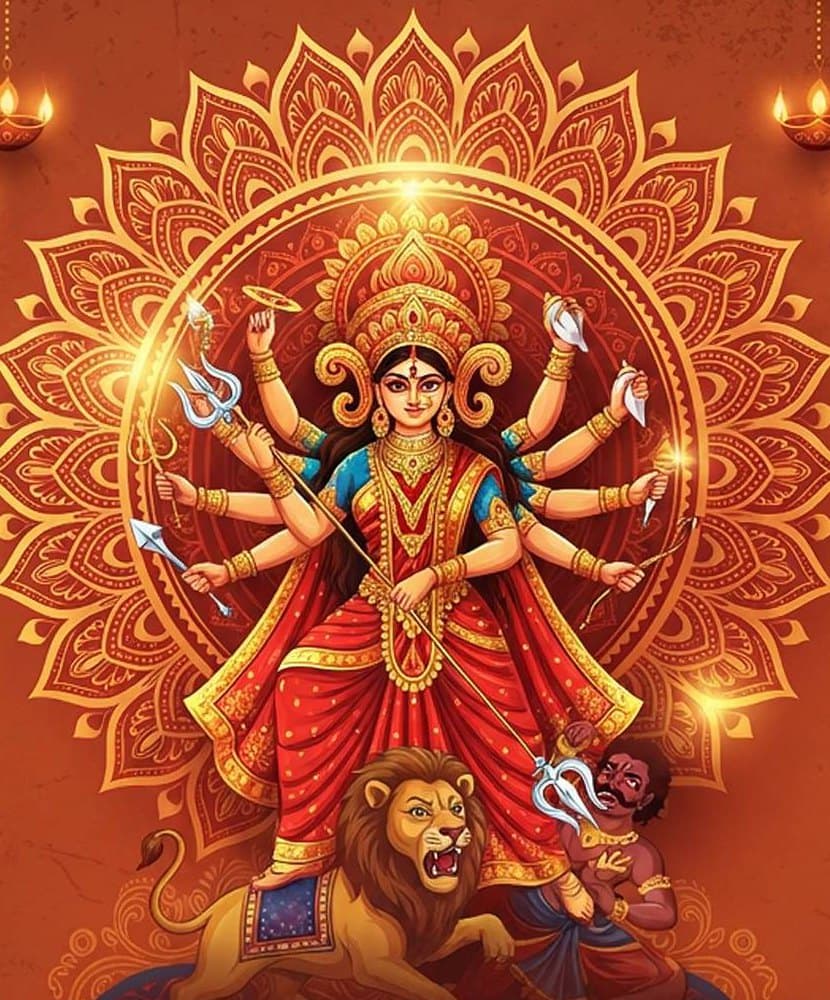
Reading the image - every detail has a meaning:
- 1Calm face, third eye. Even in battle her face is serene. Her strength comes from wisdom, not anger - the third eye stands for insight that sees beyond appearances.
- 2Weapons from every god. The gods each gave her their own weapon - Shiva's trident, Vishnu's discus, Indra's thunderbolt and more. United, the forces of good are stronger than any one of them alone.
- 3Ten arms. Ten arms guard the ten directions: she protects her devotees wherever they are, and can do many things at once - a mother's strength.
- 4The lion. Her vahana (mount) stands for courage and power held in control. She rides it calmly: bravery guided by goodness.
- 5Mahishasura. The shape-shifting buffalo demon stands for ego, arrogance and ignorance - the 'demons' inside every person that we try to overcome.
- 6The trident strikes. The idol captures the moment of victory. It is a reminder that however strong evil seems, good wins in the end.
- 7Halo of light. She was born from the combined radiance (tejas) of all the gods, so she is shown surrounded by light.
Why it matters. Mahishasura could not be defeated by any single god - only by their united strength, in the form of the Mother. The festival celebrates that courage, unity and goodness together can overcome any evil, in the world and within ourselves.
Akal Bodhon
Why is it celebrated in autumn?
Originally the goddess was worshipped in spring (Basanti Puja, still held today). The autumn celebration comes from the Ramayana as retold in Bengali by the poet Krittibas in the 15th century: before his battle with the demon king Ravana, Prince Rama needed Durga's blessing, so he woke her early - an Akal Bodhon (“untimely awakening”).
Rama offered 108 blue lotuses. When one was missing, he prepared to offer one of his own eyes - people called his eyes “lotus-like”. Moved by his devotion, Durga stopped him and blessed him, and Rama went on to win. Bengalis have followed his example ever since, and that is also why 108 lotuses are offered during the Sandhi Puja.
Why it matters. It explains the timing of the festival, and shows that the Goddess answers sincere devotion - even outside the 'proper' time.
A daughter's visit
Uma comes home
For Bengalis, Durga is not only a warrior goddess - she is also Uma, a beloved daughter. She lives far away on Mount Kailash with her husband Shiva, and once a year she comes home to her parents, Himalaya and Menaka, bringing her four children with her.
The Puja days are her visit. The welcome on the first day is full of excitement, and the farewell on Dashami is bittersweet - like saying goodbye to a daughter who must go back to her in-laws' home. People say “Asche bochor abar hobe” - “she will come again next year”.
Why it matters. This is why Durga Puja feels like a family reunion: people travel home, wear new clothes, cook together and welcome guests - just as a family welcomes a daughter home.
Who's who
Durga's family
In a traditional Bengali idol (protima) Durga stands at the centre with her four children beside her. Each has an animal mount (vahana) and brings a blessing for a complete, happy life:
Lakshmi
Goddess of wealth & prosperity
Mount: Owl. The owl sees in the dark: prosperity should come with wisdom, not greed.
Saraswati
Goddess of knowledge, music & the arts
Mount: Swan. A swan is said to separate milk from water - true knowledge tells the good from the bad.
Ganesha
Remover of obstacles, god of new beginnings
Mount: Mouse. A tiny mouse carries the great Ganesha: even the smallest effort can overcome big obstacles.
Kartik
God of courage & protection, commander of the gods' army
Mount: Peacock. The proud, beautiful peacock stands for confidence and discipline.
Shiva, her husband, is often shown at the top of the frame, and next to Ganesha stands the Kola Bou - a banana plant dressed as a bride (see Saptami below).
From scripture to street festival
A short history
c. 400–600 CE
The Devi Mahatmya
The story of Durga and Mahishasura is written down in the Devi Mahatmya, part of the Markandeya Purana. Its 700 verses - the Chandi - are still recited during the Puja.
15th century
Autumn worship in Bengal
Krittibas's Bengali Ramayana makes Rama's autumn Akal Bodhon famous, and the autumn Durga Puja becomes Bengal's great festival.
16th–18th century
Royal and household Pujas
Kings and wealthy landlords (zamindars) hold grand Pujas at home - Raja Kangsanarayan of Taherpur is often credited with one of the earliest, and Kolkata's Shobhabazar Rajbari Puja began in 1757. Many of these family Pujas continue today.
Around 1790
The community Puja is born
In Guptipara, twelve friends pooled their money to hold a Puja together - the baro-yari ('twelve friends') Puja. The festival starts to belong to the community, not only to the rich.
20th century
Sarbojanin - a Puja for everyone
Public Pujas open to all, regardless of caste, class or background, spread across Kolkata and Bengal. Pandals become giant works of art, and Bengalis carry the festival with them around the world.
2021
World heritage
UNESCO inscribes 'Durga Puja in Kolkata' on its Representative List of the Intangible Cultural Heritage of Humanity, recognising it as a festival of art, community and inclusion.
Why it matters. Durga Puja grew from a royal ritual into a festival that belongs to everyone. That spirit - sarbojanin, “for all people” - is exactly what community Pujas like ours in Kuopio continue.
Day by day
The days of the Puja
In Bengal the festival runs from Mahalaya through five main days. Like many communities outside India, we hold a shorter Puja in Kuopio (16–17 October) that brings the most important rituals together - see our program details.
Day 0 · the prelude
Mahalaya
Marks the start of Devi Paksha, the 'fortnight of the Goddess'. At dawn people offer prayers to their ancestors (tarpan) and listen to Mahishasuramardini, a radio recitation of the Chandi broadcast every year since the 1930s.
Why: It is the invitation: the countdown to the Goddess's arrival begins.
Day 1
Shashthi
Bodhon - the Goddess is ritually awakened under a bel (wood-apple) tree, and her face is unveiled. The idol is welcomed with lamps, conch shells and the sound of the dhak.
Why: Just as Rama awakened her, the community 'wakes' the Goddess and invites her into the pandal.
Day 2
Saptami
At dawn the Nabapatrika - nine plants tied together with a banana plant, dressed as a bride and called Kola Bou - is bathed and placed beside Ganesha. The Goddess's life is invoked into the idol (pran pratishtha).
Why: The nine plants link the Goddess to nature and the harvest - a reminder of the festival's farming roots.
Day 3
Ashtami
The most important day. Crowds gather in new clothes for Pushpaanjoli (flower offering). Many places hold Kumari Puja, worshipping a young girl as the Goddess. At the meeting of Ashtami and Navami comes Sandhi Puja: 108 lamps and 108 lotuses, when Durga is believed to have slain the demons Chanda and Munda.
Why: It is the high point of the battle, and of devotion.
Day 4
Navami
Final prayers, a great aarti, and Proshadom - food first offered to the Goddess and then shared with everyone. It is the last full day of celebration, full of music and togetherness.
Why: Sharing blessed food as equals is at the heart of a community Puja.
Day 5
Dashami
The day of victory and farewell. Married women offer sindoor (vermilion) to the Goddess and to one another (Sindoor Khela), the idol is taken for immersion (bisarjan), and everyone exchanges Bijoya greetings and sweets.
Why: Victory is celebrated, but so is the promise of return: the immersion reminds us that everything in life comes and goes - and comes again.
What you will see
Rituals and their meaning
Puja & Aarti
A priest (purohit) chants Sanskrit mantras and makes offerings of flowers, water, incense and food. In the aarti he waves lamps, incense, a conch of water, cloth and a fan before the Goddess, to the beat of the dhak. Lamp light is offered because light drives away darkness - ignorance and fear.
Why it matters. Each ritual treats the Goddess as an honoured guest in the home - she is bathed, dressed, fed and entertained with love.
Pushpaanjoli - the flower offering
Everyone gathers holding flowers and bel leaves and repeats the priest's mantra in three rounds, then offers the flowers to the Goddess. Traditionally devotees fast until they have given anjali in the morning (optional - all are welcome to take part). In Kuopio, Pushpaanjoli follows the Puja Aarti on both days.
Why it matters. It is the most personal moment of the Puja: every person, of any age, offers their own prayer directly to the Mother.
Proshadom & Prasad
Proshadom is food cooked with care and offered to the Goddess - traditionally vegetarian, such as khichuri (rice and lentils), mixed vegetables, chutney and sweets. Once offered, it becomes prasad, a blessing, and is served to all guests.
Why it matters. Food blessed by the Goddess is shared by everyone, sitting together as equals - the simplest expression of community.
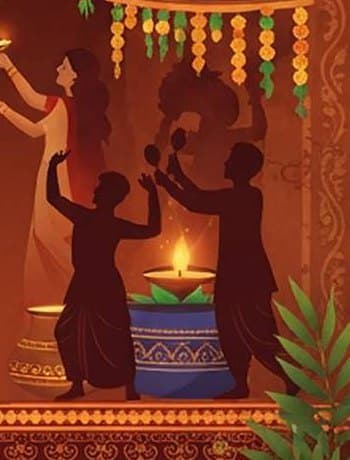
Dhak & Dhunuchi dance
The dhak is a large barrel drum decorated with white feathers, played by a dhaki during every ritual. In the evening aarti people dance the dhunuchi naach, swaying with clay burners full of smoking coconut husk and incense (dhuno) - a joyful offering of fragrance and rhythm.
Why it matters. The dhak is the heartbeat of the Puja: for Bengalis, its sound alone means the Goddess has arrived.
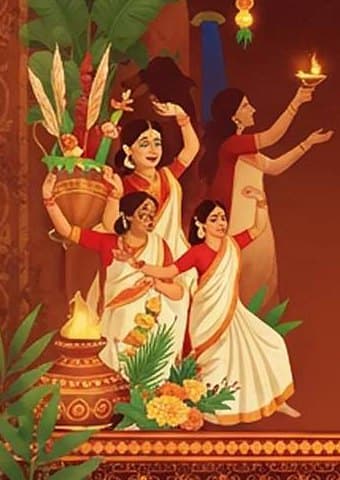
Sindoor Khela
On Dashami, women - traditionally married women, today often everyone who wishes - dressed in white saris with red borders offer sindoor (vermilion) and sweets to the Goddess, then smear sindoor on each other's faces. Sindoor is a symbol of blessing, strength and a long, happy married life.
Why it matters. Before the Goddess leaves, women bless her and each other with the colour of good fortune - a farewell filled with joy rather than sadness.
Bisarjan & Bijoya
The Goddess is bid farewell and the idol is immersed in water (bisarjan) - the clay returns to nature. Then comes Bijoya: people embrace, younger ones touch elders' feet for blessings, and everyone shares sweets and says “Shubho Bijoya”.
Why it matters. Bijoya is about renewing relationships: forgiving, reconnecting and wishing each other well for the year ahead.
Our celebration
Why we celebrate in Kuopio
Kuopio Durga Puja is organised by KRIPA and our volunteers. Many of us - students, researchers, professionals and families - live far from India and Bangladesh. For us, the Puja keeps our traditions alive, gives our children the chance to grow up knowing these stories, and brings the community together in the middle of a Finnish autumn.
Just like the sarbojanin Pujas of Bengal, ours is for everyone: Finnish neighbours, international friends and anyone curious are warmly invited to watch, ask questions, share Prasad and take part. Registration is mandatory so we can plan food and space for everyone.
Why it matters. A Puja is a home for people far from home, a place for children to learn where they come from, and an open door for new friends.
Good to know
First-time visitor guide
Do I need to be Hindu or Bengali to come?
Not at all. Everyone is welcome to attend, watch the rituals, join Pushpaanjoli if they wish, enjoy the cultural program and share Prasad.
What should I wear?
Anything comfortable and respectful. Many people wear traditional clothes - saris, salwar kameez, kurta or panjabi - and you are welcome to as well, but it is not required.
Do I need to take my shoes off?
Yes, near the altar area and during Pushpaanjoli. Volunteers will show you where.
Can I take photos?
Yes - but please avoid flash during the rituals and ask people before photographing them closely. Note that the organisers photograph and film the event.
Can I take part in Pushpaanjoli?
Yes. You will be given flowers; just repeat after the priest or simply follow along quietly and offer the flowers when everyone does.
Is there food?
Yes - Prasad is shared after the Puja and is traditionally vegetarian. Let us know in the registration form if you will join.
Can I bring my children?
Of course! Children are at the heart of the celebration.
Can I donate?
Yes, if you wish - donations are voluntary and help cover the puja, decorations and Proshadom. Use the Donate button on the home page or give in person at the venue.
Why is registration mandatory?
It helps us plan food, seating and space for everyone, and makes entry quicker on the day.
Glossary
Words you'll hear
- Shubho Sharodiya
- “Happy autumn festival” - the Puja greeting.
- Maa
- Mother - how devotees lovingly call Durga.
- Pujo / Puja
- Worship; also the festival itself.
- Protima
- The clay idol of the Goddess and her family.
- Pandal
- The temporary structure that houses the idol.
- Purohit
- The priest who performs the rituals.
- Pushpaanjoli
- Offering flowers with prayers.
- Proshadom / Prasad
- Food offered to the Goddess / the blessed food shared afterwards.
- Aarti
- Worship by waving lamps and incense.
- Dhak / Dhunuchi
- The festival drum / the clay incense burner used in dance.
- Sindoor Khela
- The vermilion ceremony on Dashami.
- Bisarjan
- Immersion of the idol; the farewell.
- Bijoya
- Greetings of victory and goodwill after Dashami.
- Asche bochor abar hobe
- “It will happen again next year!” - said at the farewell.
Happy Durga Puja
Join us on 16–17 October 2026
Kulttuuriareena 44, Kuopio · All are welcome